
Quick Answer
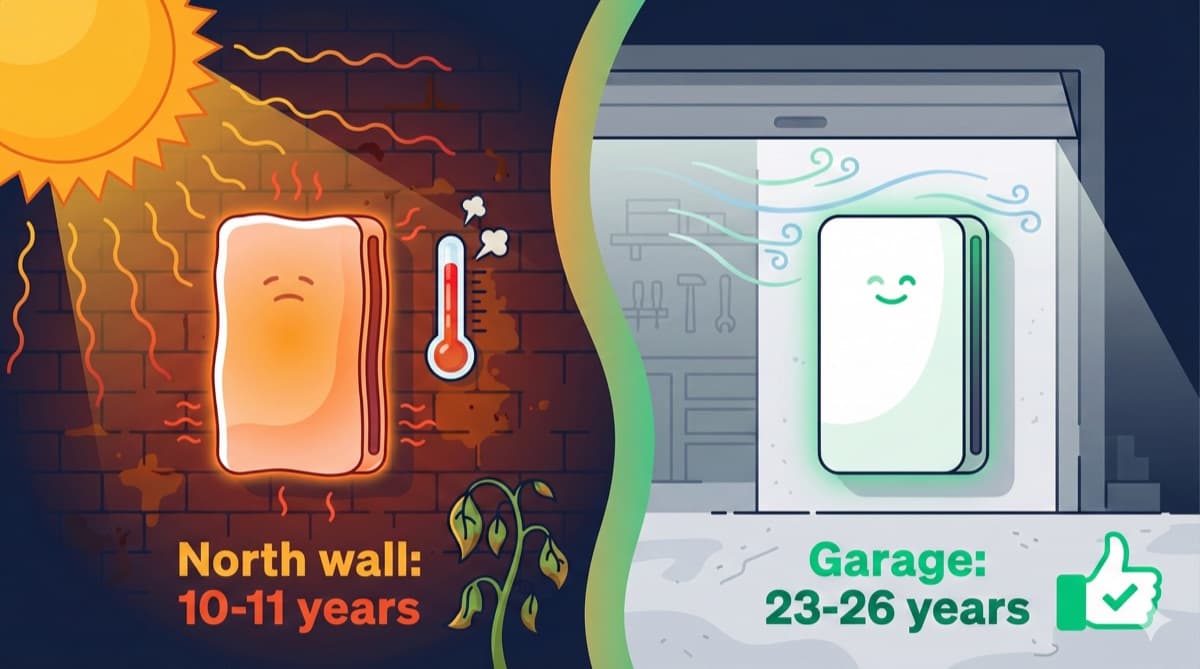
At Battery IQ, we analysed peer-reviewed research on LFP battery degradation and found that installation location is the single biggest factor you can control. The same battery lasts 10-11 years on a north-facing wall but 23-26 years in a garage. That's more than double the lifespan. If your installer isn't discussing placement, you need a second opinion. Below: the science explained simply, a practical location guide with quantified impact, and 4 questions to ask your installer.
Every battery advertisement says the same thing: "10-15 year lifespan." It's on the brochures, the websites, and every installer's pitch deck. But what does that actually mean? Is that a guarantee? A best case? An average?
We went deep into peer-reviewed research to find out. What we discovered is that the lifespan question has a much more interesting answer than the industry lets on. And the single biggest factor that determines how long your battery lasts isn't the brand, the warranty, or even the chemistry. It's something most installers barely mention.
What You'll Learn
- The science of battery degradation explained with zero jargon
- Why installation location matters more than brand with quantified data for 5 common placements
- How a $500-2,000 install upgrade can double your battery's life and avoid a $20,000+ replacement at full price
- 4 questions to ask your installer that separate the good ones from the ones cutting corners
What Type of Battery Is in Your Home?
Here's something most people don't realise: virtually every home battery sold in Australia today uses the same fundamental chemistry. It's called LFP - Lithium Iron Phosphate (or LiFePO4 if you want to sound impressive at dinner parties).
LFP was invented in 1996 by a materials scientist named John Goodenough at the University of Texas. The technology was commercialised between 2005 and 2010, and it gradually took over the home battery market because it solved the three biggest problems with earlier lithium-ion batteries: safety, longevity, and cost.

The Man Named Goodenough
Yes, the inventor of modern battery technology was literally named Goodenough. John Goodenough was 97 years old when he won the Nobel Prize in Chemistry in 2019, making him the oldest Nobel laureate in history. He passed away on June 25, 2023, at the age of 100. Every battery on your wall exists because of his work at the University of Texas. Rest in peace, Professor - your invention was more than good enough.
LFP is different from the NMC (Nickel Manganese Cobalt) chemistry used in most electric vehicles. NMC packs more energy into a smaller space, which matters when you're trying to fit a battery under a car. But for a home battery sitting on your wall, LFP wins on every metric that actually matters:
- Safer - no thermal runaway risk (it won't catch fire)
- Longer cycle life - 6,000-10,000 cycles vs 2,000-3,000 for NMC
- Handles deep discharge - you can use more of the rated capacity without damage
- Cheaper to manufacture - no cobalt or nickel needed
Our battery comparison guide lists Tesla Powerwall 3, BYD Blade, Sungrow, and Sigenergy - and they all use LFP. Even Tesla switched from NMC chemistry in the Powerwall 2 to LFP in the Powerwall 3. The market has spoken: LFP is the right chemistry for a device that sits on your wall for decades.
Has Any Home Battery Actually Lasted 20 Years?
This is the truth the industry doesn't talk about: no.
LFP was commercialised around 2005-2010. The oldest installations in the world are roughly 15-20 years old. There is no published long-duration field study spanning 20+ years for any LFP battery. Not one.
So where do all the "20-25 year" claims come from? Three places:
- Accelerated aging studies at elevated temperatures (cook the battery faster to simulate time)
- Electrochemical models using SEI growth kinetics (mathematical predictions based on known chemistry)
- Calendar aging tests over 1-3 years, extrapolated forward using mathematical models
These models are credible. They're published in peer-reviewed journals like ACS Applied Energy Materials, MDPI, and Frontiers in Energy Research. The underlying chemistry is well understood. But there's a difference between a credible prediction and a proven fact.
The battery research community openly acknowledges this gap. A 2021 MDPI study on LFP long-term calendar aging and a 2025 MDPI study on aging factors both note the limitations of extrapolating from accelerated tests to real-world decades.
The Honest Truth
When someone tells you a battery will last 20 years, they're making a prediction based on accelerated lab tests and mathematical models. Those models come from legitimate peer-reviewed research, and we have good reason to trust them. But nobody has actually watched an LFP battery age for 20 years yet. We think that's worth knowing.
Why This Makes Smart Choices Even More Important
This is exactly why maximising the rebate alone isn't enough. The real return on investment comes from pairing your battery with the right retail or wholesale energy plan and making smart electrification choices across your whole home. At Battery IQ, in more than 9 out of 10 cases we see strong ROI when homeowners go beyond just "cheapest price today" and think about long-term value. The battery is the foundation, but the strategy around it is what makes the numbers work.
What Are the Three Things That Wear Out Your Battery?
Battery degradation sounds complicated, but it comes down to three things. We'll keep it simple here - if you want the full chemistry, there's a Technical Deep Dive at the bottom.
1. The Slow Break
Imagine a brick wall. Over time, individual bricks loosen and fall out. Each one is tiny, but eventually the wall gets weaker. That's what happens inside your battery - tiny pieces of the electrode lose contact and can't store energy anymore.
This is the one that causes the most drama. It's the reason batteries eventually hit what researchers call the "aging knee" - where degradation speeds up. More on that in the next section.
2. The Slow Rust
Think about how copper pipes develop a coating over time. Your battery does something similar - a protective layer slowly builds up inside it. The problem? Every bit of that layer permanently traps a tiny amount of the battery's charge-carrying capacity.
The silver lining: this process is fast at first, then slows down as the layer gets thicker. Most of the damage happens in the first few years, then it settles.
3. The Slow Dry
Your battery contains a liquid that carries charge back and forth. Think of it like brake fluid in your car - it works perfectly for years, but it slowly breaks down. And there's only a fixed amount in there.
This is what ultimately puts a ceiling on battery life at the 20-25 year mark, even if everything else is fine.
The Key Insight
Types 2 and 3 happen whether you use the battery or not - they're driven by time and temperature. Type 1 is driven by usage. Your battery ages just sitting there, and it ages when you use it. Both clocks are always ticking. And the thing that speeds up all three? Heat.
What Is the "Aging Knee" and Should You Worry?
Batteries don't suddenly die. They gradually lose capacity over time. But there is a point where degradation shifts from a slow, predictable fade to a faster decline. Researchers call this the "aging knee."
Before the knee: slow, predictable fade of about 1-2% capacity per year. This is the boring, comfortable part where you barely notice anything.
After the knee: the "bricks falling out of the wall" mechanism from the previous section kicks in harder. Capacity drops more noticeably.
Battery Capacity Over Time
Illustrative curve based on accelerated aging studies. Actual degradation varies by usage, temperature, and installation conditions.
Lab studies found that cells reached the knee between 700-1,200 equivalent full cycles. But home batteries rarely do full cycles daily - most operate at around 60% depth of discharge, which is significantly gentler. This extends the time to the knee considerably.
The warranty is designed to cover you through the knee. Most manufacturers guarantee 70-80% capacity at 10 years. After the knee, the battery doesn't stop working. It just loses capacity faster. You'll notice shorter backup duration and less energy available, but the system keeps functioning.
| Period | What's Happening | Typical Capacity | How It Feels |
|---|---|---|---|
| Years 0-5 | Protective layer building up (fast at first, then slows) | 92-97% | "Battery seems fine" |
| Years 5-10 | Protective layer still growing, some wear starting | 80-92% | "Maybe slightly less backup" |
| Years 10-15 | Approaching the "aging knee" for daily-cycled batteries | 70-80% | "Noticeably shorter duration" |
| Years 15-20 | Internal fluid wearing out, general aging | 60-70% | "Still works, but less capacity" |
| Years 20+ | Internal fluid running low | 50-60% | "Works, but limited power" |
What Is the Single Biggest Factor You Can Control?
Temperature. Full stop.
Of the three degradation mechanisms we just covered, all three are accelerated by heat. SEI growth speeds up. Electrolyte decomposition accelerates. Active material loss gets worse. Heat is the universal enemy of battery longevity.
Research consistently shows this relationship: every 10 degrees C increase roughly doubles the degradation rate. This isn't a rough estimate - it follows well-established Arrhenius kinetics that have been validated across hundreds of studies.
To put it in practical terms: cell lifetime at 55 degrees C is approximately one-seventh of lifetime at 25 degrees C. That's not a typo. Seven times faster degradation.
You can't control time. You can't change the chemistry. But you can control where you install the battery. And that makes installation location the single most important decision in the entire process.
Key Point
Temperature is the single biggest factor that determines how long your battery actually lasts. Every 10 degrees hotter roughly doubles the degradation rate. A battery baking on a north-facing wall at 45 degrees degrades four times faster than one sitting in a cool garage at 25 degrees.
Where Should You Install Your Battery?
This is where the research gets practical. We modelled the impact of different installation locations on battery lifespan using Arrhenius-weighted average temperatures across a full year in Melbourne. The differences are dramatic.
North Wall - Direct Sun
Summer cell temp ~45 degrees C · 1.83x degradation
capacity
West Wall - Afternoon Sun
Summer cell temp ~38 degrees C · 1.3x degradation
capacity
East Wall - Morning Sun
Summer cell temp ~33 degrees C · 1.05x degradation
capacity
South Wall - Always Shaded
Summer cell temp ~32 degrees C · 0.83x degradation
capacity
Inside GarageBest
Summer cell temp ~28 degrees C · 0.77x degradation
capacity
Based on Arrhenius-weighted temperature modelling across a full Melbourne year. Same battery, same brand - only the location changes.
Let that sink in. The same battery - same brand, same model, same warranty - could last 10 years or 26 years depending on where your installer puts it.
Why Each Location Matters
North wall: In Australia, north-facing walls get hours of direct sun. The brick absorbs heat and re-radiates it. The battery enclosure becomes a solar oven. Summer cell temperatures can easily reach 45 degrees C or higher, and the wall stays hot well into the evening.
West wall: Gets brutal afternoon sun during the hottest part of the day in summer. Not quite as bad as north, but still punishing. The thermal load peaks when ambient temperatures are already at their highest.
East wall: Only gentle morning sun. By the time temperatures peak in the afternoon, this wall is in shade. A decent option if you can't go south or inside.
South wall: In Australia, south-facing walls never get direct sun. This is the opposite of the northern hemisphere - your south wall is the cool side. Good option for external installation.
Inside garage: Best thermal protection. Sheltered from radiant heat, protected from weather, and the thermal mass of the building stabilises temperature. A concrete slab floor at ground level adds additional cooling. This is the gold standard for battery longevity.
Other Factors That Matter
- Wall colour: Dark brick absorbs and re-radiates heat. A light rendered wall is noticeably better.
- Air gap: 50-100mm behind the battery allows convective cooling. A flush mount against brick is a heat trap.
- Nearby heat sources: Keep the battery away from AC condensers, hot water systems, and dryer vents.
- Ventilation: If you build an enclosed battery cupboard, it needs airflow. A sealed box becomes a slow cooker.
- Concrete slab: Ground level installations benefit from the thermal mass of the slab, which stays cool relative to ambient air.
What NOT to Worry About
- Rain and weather: Modern batteries carry IP65 or IP66 ratings. They handle rain, dust, and humidity just fine.
- Cold: LFP loves cold. Melbourne winter temperatures of 5-15 degrees C are ideal for battery longevity. Cold slows all three degradation mechanisms. If anything, your battery is happiest in winter.
Know Your Numbers Before Talking to an Installer
Our free calculator analyses your bill, your usage, and your energy plan to show you the full picture - not just battery size, but the ROI case for your specific situation. Go in informed.
Get My Free Battery ReportHow a Smart Install Can Double Your Battery's Life
Let's talk money. A battery on a north wall lasts 10-11 years. The same battery in a garage lasts 23-26 years. That's not a small improvement - it's more than double the lifespan. And the cost difference? A longer cable run and a bit more labour. Here's how the numbers stack up:
| "Cheap" North Wall Install | "Smart" Garage Install | |
|---|---|---|
| Extra cable/labour* | $0 | +$500-2,000 |
| Battery life to 80% | ~10-11 years | ~23-26 years |
| Cost per year of battery life | $1,500-2,000/yr | $600-850/yr |
| Likely replacement needed? | Yes, within 12-15 years | No |
| Replacement cost** | $20,000-25,000+ | $0 |
*Extra cost depends on cable run length and what it runs through. A short run through a roof cavity might be $500. A longer run with conduit through walls or trenching could be $1,500-2,000. Ask your installer for a quote on both locations so you can compare.
**You can only claim the federal battery rebate once. A replacement battery in 10-12 years will be at full price with no rebate. These figures are based on today's pricing - we don't know what batteries will cost in a decade, but you shouldn't count on a second rebate to soften the blow.
The Bottom Line
Even at the top end, spending $2,000 more on a smarter install location can more than double your battery's lifespan and avoid a $20,000-25,000+ replacement at full price (remember, you only get the rebate once). This is the single highest-ROI decision in your entire battery journey.
And there are hidden costs beyond replacement:
- Warranty implications: If the battery degrades past 70% at year 8 because of heat exposure, you may end up fighting the manufacturer for a warranty claim. Operating temperature ranges are specified for a reason, and exceeding them can void coverage.
- Lower efficiency from higher resistance: A hot battery has higher internal resistance, which means more energy is lost as waste heat during every charge and discharge cycle. That's higher running costs every single year.
- BMS throttling on extreme heat days: The Battery Management System will throttle power output to protect the cells when temperatures are too high. This means reduced performance on the exact days you need the battery most - the 40 degree C days when your air conditioning is running flat out.
What Should You Ask Your Installer?
If your installer isn't proactively talking to you about the best location for your battery, that's a red flag. This should be one of the first conversations, not an afterthought. A good installer will discuss temperature, sun exposure, and the trade-offs involved. If they can't answer these questions - or if they say location doesn't matter - get a second opinion.
1. "Where do you recommend installing the battery and why?"
Good answer: They talk about temperature, sun exposure, and the trade-offs between cable run length and thermal performance.
Red flag: "Wherever is easiest" or "It doesn't really matter." Also watch for "right next to the meter box" without discussing alternatives. That's the cheapest install for them - shorter cable run, less labour, lower quote to beat competitors. But the meter box is often on a sun-exposed wall, which is the worst place for your battery's lifespan.
2. "What's the temperature range where you're proposing to install it?"
Good answer: They've thought about summer peak temperatures and ambient conditions at the proposed location.
Red flag: They've never measured or considered it.
3. "Can we run a longer cable to get it in a better location?"
Good answer: "Yes, here's the trade-off in cost versus cable losses. For an extra $X we can run it to the garage, and the cable loss is negligible."
Red flag: "That would be too expensive" without explaining the actual cost or why.
4. "What's the warranty impact of installation location?"
Good answer: They discuss operating temperature ranges in the warranty terms and how installation affects those conditions.
Red flag: "The warranty covers everything no matter what."
A Word of Caution
If your installer says installation location doesn't affect battery life, they're ignoring decades of published research. Every major manufacturer specifies operating temperature ranges for a reason. A good installer plans for the battery to last 15-20 years, not just to survive the first summer.
Technical Deep Dive: The Research Behind This Guide
This section covers the actual science with journal citations for readers who want to go deeper. If you've already got what you need from the sections above, feel free to skip to the bottom.
The Three Degradation Mechanisms in Detail
In the main guide we used simple analogies. Here's what's actually happening at a chemical level:
SEI Layer Growth ("The Slow Rust"): The Solid Electrolyte Interphase forms on the graphite anode surface. Each molecule permanently traps one lithium ion, reducing the cell's charge-carrying capacity. This process is called Loss of Lithium Inventory (LLI). It follows a square root of time pattern - fast initially, then self-limiting as the layer thickens and acts as its own barrier.
Electrolyte Decomposition ("The Slow Dry"): The liquid electrolyte that transports lithium ions between electrodes slowly breaks down through parasitic side reactions, especially at elevated temperatures. There is a finite volume in each cell. Once depleted past a critical threshold, ionic transport is impaired and internal resistance rises sharply.
Loss of Active Material ("The Slow Break"): Fragments of the graphite anode lose electrical contact with the current collector, becoming electrochemically inactive. Wheeler et al. (2024) identified Loss of Active Material at Negative Electrode (LAM_NE) as the dominant mechanism driving the aging knee, where degradation accelerates from a linear fade to a steeper decline.
The Arrhenius Relationship
Battery degradation follows Arrhenius kinetics, one of the most fundamental relationships in chemistry. The rate equation is:
Where Ea is the activation energy (approximately 40-60 kJ/mol for LFP degradation), R is the gas constant, and T is absolute temperature. The practical implication is straightforward: degradation rate roughly doubles per 10 degrees C increase. This has been validated across numerous studies, including the MDPI 2025 study on calendar and cycle aging factors.
SEI Growth Kinetics
The SEI layer grows following a sqrt(t) relationship, where thickness increases proportionally to the square root of time. The primary mechanism is electrolyte reduction at the graphite anode surface.
The ACS Applied Energy Materials (2024) study found that SEI thickness exceeded 300nm and conductivity loss surpassed 20% after 36 months at 55 degrees C and 90% state of charge. At 25 degrees C, this same process takes dramatically longer - roughly 7x longer based on the Arrhenius relationship.
The Wheeler et al. Study (2024)
Full title: "Aging in First and Second Life of G/LFP 18650 Cells." Conducted at Universite Claude Bernard Lyon and published in the Batteries journal. This study is particularly valuable because the researchers aged G/LFP cells down to 40% State of Health - far beyond where most studies stop.
Key findings:
- The aging knee appeared between 700-1,200 equivalent full cycles
- Loss of Active Material at Negative Electrode (LAM_NE) is the dominant mechanism in long-term aging
- Different cells reached the knee at different times under identical conditions, highlighting the inherent variability in battery aging
- Cells continued to function below 40% SoH, just with significantly reduced capacity
LFP vs NMC Calendar Aging
A semi-empirical aging model study (2023) published in the Journal of Energy Storage found that LFP calendar aging is roughly 3-5x slower than NMC under identical conditions. The primary reason is voltage: LFP operates at lower cell voltages (2.5-3.65V per cell) compared to NMC (3.0-4.2V per cell). At lower voltages, the electrolyte is more thermodynamically stable, reducing the rate of parasitic side reactions.
This is why the entire Australian home battery market has moved to LFP. The lower energy density compared to NMC is irrelevant for a wall-mounted battery, and the longevity advantage is substantial.
Our Temperature Modelling
We modelled three Melbourne installation scenarios across a full year using Arrhenius-weighted average temperatures. Rather than using simple averages (which understate the impact of heat), we weighted each temperature by its Arrhenius degradation factor, because damage is exponential.
- North wall: 90 days at ~45 degrees C effective, 180 days at ~30 degrees C, 95 days at ~18 degrees C = 1.83x baseline degradation
- Garage: 90 days at ~28 degrees C, 180 days at ~20 degrees C, 95 days at ~14 degrees C = 0.77x baseline
The key insight: damage is exponential, so a few hot weeks cause disproportionate damage. The 10-15 extreme heat days (40 degrees C+ ambient) in Melbourne contribute more cumulative degradation than the entire winter period. This is why average annual temperature is misleading - peak temperature exposure matters far more.
Sources
Wheeler et al. (2024) - "Aging in First and Second Life of G/LFP 18650 Cells" - hal.science/hal-04911791v1
ACS Applied Energy Materials (2024) - "Deciphering Calendar Aging of LFP-Graphite" - pubs.acs.org/doi/10.1021/acsaem.4c02761
MDPI Applied Sciences (2025) - "Calendar and Cycle Aging Factors" - mdpi.com/2076-3417/15/23/12749
Frontiers in Energy Research (2025) - "Grid Storage Aging" - frontiersin.org/journals/energy-research
MDPI Energies (2021) - "LFP Long-Term Calendar Aging" - mdpi.com/1996-1073/14/6/1732
Journal of Energy Storage (2023) - "Semi-empirical LFP vs NMC Aging Model" - sciencedirect.com
Content reviewed by Battery IQ Energy Analysts | Sources: ACS Applied Energy Materials, MDPI, Frontiers in Energy Research, Universite Claude Bernard Lyon | Last updated: 16 February 2026
Ready to Make the Right Battery Decision?
Our free calculator helps you find the right battery for your home. And we'll make sure your installer knows where to put it.
Get My Free Battery ReportRelated Articles
Home Battery Comparison 2026
Compare Tesla, BYD, Sungrow, and Sigenergy on specs, price, and ROI.
Federal Battery Rebate 2026
Complete guide to the Cheaper Home Batteries Program and rebate amounts.
What Is a VPP?
Understanding Virtual Power Plants and battery earning strategies.
Are Batteries Stabilising the Grid?
AEMO data analysis on how home batteries are changing wholesale prices.